

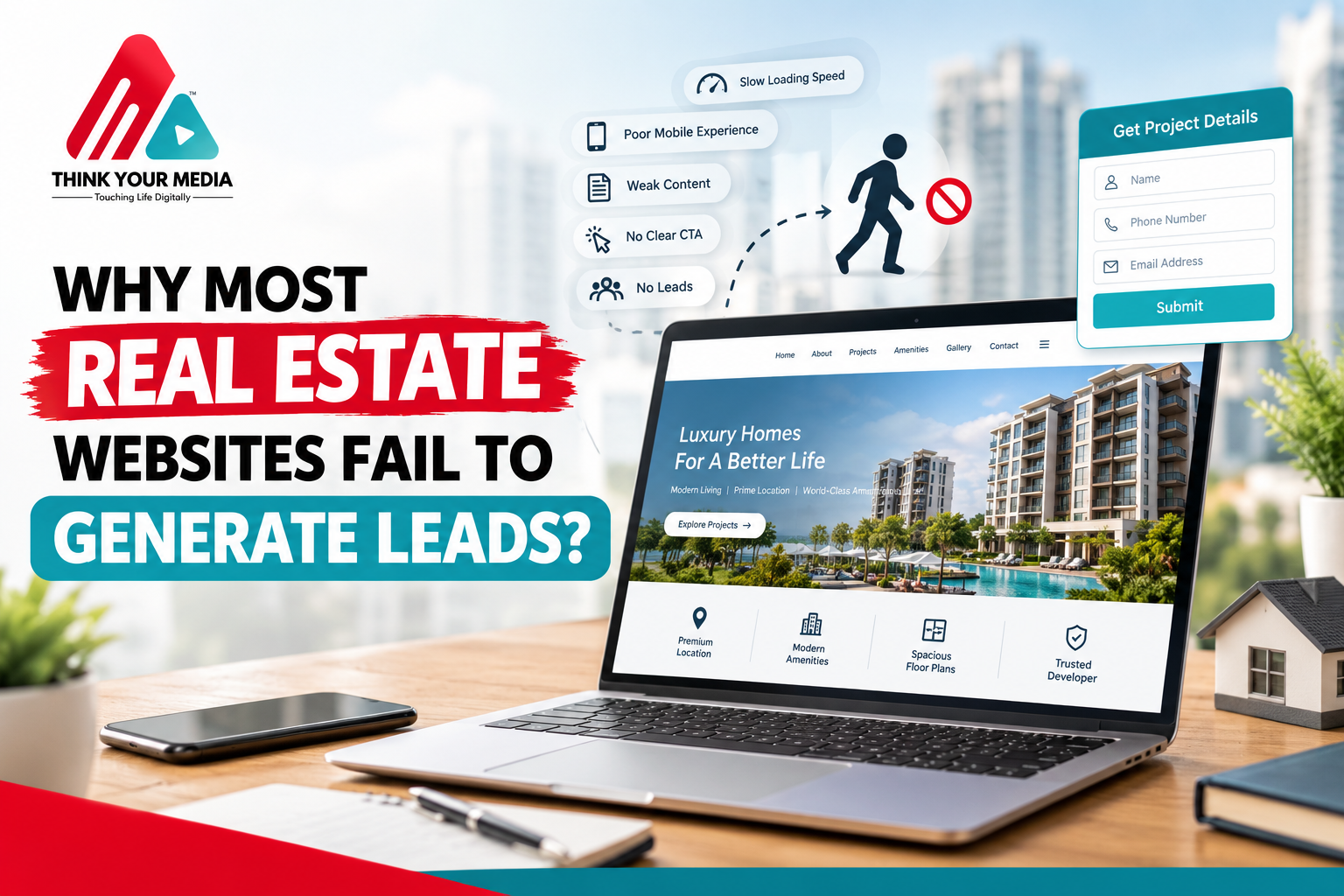
Why Most Real Estate Websites Fail to Generate Leads
A real estate website should be one of the strongest lead-generation assets for any developer, builder, or property consultant. Yet many real estate businesses invest heavily in website design and still struggle to generate consistent enquiries.
The problem is rarely traffic alone. In most cases, potential buyers are visiting the website but leaving without taking any action. Poor user experience, weak content, slow loading speeds, and ineffective lead-capture systems often prevent websites from converting visitors into prospects.
The truth is that a real estate website is not just an online brochure. It should function as a lead-generation machine that guides visitors toward booking a site visit, requesting a brochure, or speaking with the sales team.
Let’s explore the biggest reasons why most real estate websites fail to generate leads.
They Focus on Design More Than Conversions
Many developers prioritize visual appeal without considering how visitors interact with the website.
While attractive design is important, buyers primarily visit a property website to find information.
They want answers to questions such as:
- What is the project price?
- Where is it located?
- What amenities are available?
- What are the floor plans?
- How can I schedule a site visit?
A website that looks beautiful but fails to guide users toward an enquiry form will struggle to generate leads.
A professional real estate digital marketing agency focuses on both design and conversion optimization.
Slow Loading Speed Drives Visitors Away
Website speed directly impacts user experience.
Research consistently shows that visitors abandon websites that take too long to load.
Common causes of slow websites include:
- Large image files
- Poor hosting
- Excessive plugins
- Unoptimized code
- Heavy animations
For real estate businesses, every lost visitor represents a potential lead.
Fast-loading websites not only improve user experience but also support SEO performance and lead generation.
No Clear Call-to-Action
One of the most common mistakes on real estate websites is the absence of strong call-to-action buttons.
Visitors should immediately know what action to take next.
Examples include:
- Book a Site Visit
- Download Brochure
- Request Price List
- Talk to a Property Expert
- Get Project Details
Without clear CTAs, visitors often browse a few pages and leave.
Businesses investing in digital marketing services for real estate often discover that simple CTA improvements can significantly increase enquiry rates.
Poor Mobile Experience
Most property searches now happen on smartphones.
Unfortunately, many real estate websites are still designed primarily for desktop users.
Common mobile issues include:
- Slow loading pages
- Difficult navigation
- Small text
- Broken forms
- Poor image optimization
A mobile-friendly website is no longer optional.
It is essential for capturing leads from modern property buyers.
Lack of Dedicated Landing Pages
Many developers send all traffic to a generic homepage.
This creates friction for visitors.
Instead, every project should have a dedicated landing page featuring:
- Project highlights
- Pricing details
- Floor plans
- Amenities
- Location advantages
- Lead capture forms
Dedicated landing pages typically convert better because they focus on a specific property and audience.
A digital marketing company for real estate in Noida often creates campaign-specific landing pages to improve lead generation results.
Weak Property Content
Many websites provide limited information about their projects.
Buyers want detailed content before they submit their contact information.
Useful content includes:
- Project specifications
- Construction updates
- Location benefits
- Payment plans
- Possession timelines
- Investment insights
Providing valuable information helps build trust and encourages enquiries.
This is why content strategy remains an important part of digital marketing services for real estate.
Missing Trust Signals
Buying property involves a significant financial commitment.
Visitors need reassurance before sharing their details.
Important trust elements include:
- Customer testimonials
- Project certifications
- Awards and recognitions
- Developer profile
- Google reviews
- Media coverage
Without trust signals, visitors may hesitate to engage with the brand.
An experienced real estate digital marketing agency understands how credibility impacts conversion rates.
Complicated Lead Forms
Many websites ask for too much information upfront.
Long forms can discourage visitors from submitting enquiries.
Instead, keep forms simple.
Request only essential details such as:
- Name
- Phone number
- Email address
Additional information can be collected later during the sales process.
Reducing form friction often increases lead volume.
No SEO Strategy
A website cannot generate leads if buyers cannot find it.
Search engine optimization helps attract organic traffic from users actively researching properties.
Effective SEO includes:
- Location-based content
- Keyword optimization
- Technical SEO
- Internal linking
- Blog content
- Optimized project pages
Many developers underestimate how much organic traffic can contribute to long-term lead generation.
A digital marketing company for real estate in Noida can help improve search visibility and attract qualified visitors.
Ignoring Video Content
Property buyers increasingly prefer visual content.
Videos help prospects understand:
- Layouts
- Amenities
- Project scale
- Construction progress
- Location surroundings
Embedding videos on project pages often increases engagement and time spent on the website.
Video content can also support broader digital marketing services for real estate campaigns across social media and search platforms.
No Retargeting System
Most website visitors do not convert immediately.
Without retargeting, businesses lose the opportunity to reconnect with interested prospects.
Retargeting allows developers to re-engage:
- Website visitors
- Brochure downloaders
- Video viewers
- Social media users
This keeps the project visible throughout the buyer’s decision-making process.
Poor Lead Follow-Up Integration
Lead generation does not end when someone fills out a form.
Many websites fail because they lack integration with:
- CRM systems
- WhatsApp automation
- Email workflows
- Sales notifications
Fast follow-up significantly improves conversion rates.
A quality lead can quickly become a missed opportunity if there is no response.
Why High Traffic Doesn’t Always Mean High Leads
Some real estate businesses receive thousands of website visitors every month yet generate very few enquiries.
This usually happens because:
- Traffic is not targeted
- Landing pages are weak
- CTAs are ineffective
- Trust is missing
- Forms are complicated
Lead generation depends on conversions, not just traffic.
A real estate digital marketing agency focuses on optimizing every stage of the visitor journey to improve results.
The Formula for a High-Converting Real Estate Website
Successful real estate websites generally include:
- Fast loading speed
- Mobile responsiveness
- Clear CTAs
- Dedicated landing pages
- Strong trust signals
- Valuable content
- Simple lead forms
- Video integration
- SEO optimization
- Retargeting systems
When these elements work together, websites become powerful lead-generation tools.
Conclusion
Most real estate websites fail to generate leads not because there is a lack of traffic, but because they are not designed to convert visitors into prospects. Slow speeds, poor mobile experiences, weak content, missing trust signals, and ineffective lead forms can all reduce enquiry rates.
A successful real estate website combines user experience, content, SEO, lead capture, and follow-up systems into one seamless journey. Working with an experienced digital marketing company for real estate in Noida and a results-driven real estate digital marketing agency can help transform a website from a simple online presence into a consistent source of qualified property leads.