

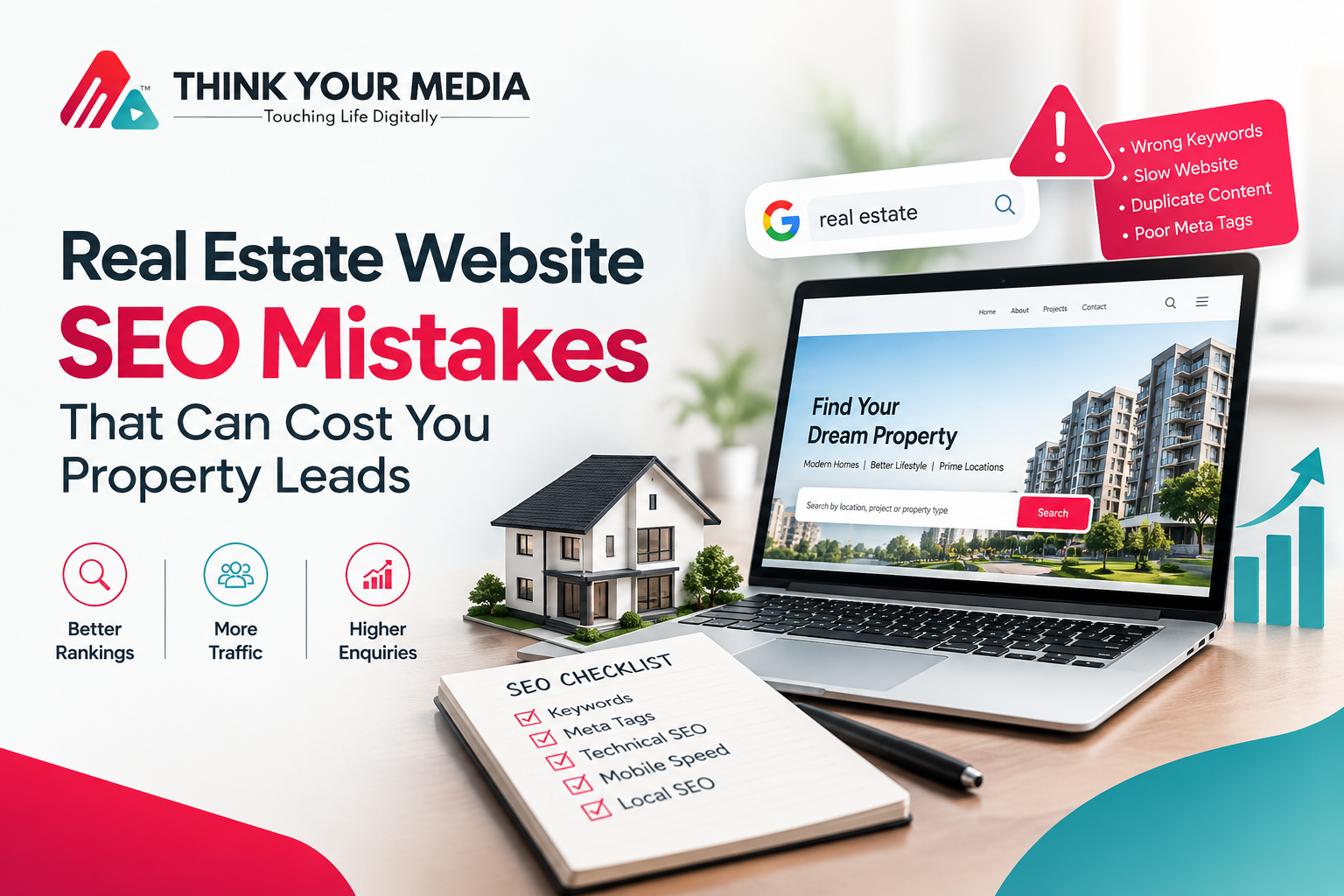
A real estate website is often the first place where a potential buyer checks your project, compares property prices, and decides whether your company is worth contacting. But having a good-looking website does not guarantee enquiries. If your website is not appearing on Google or visitors are leaving without filling out a form, there could be some SEO mistakes holding it back.
Many builders and property developers spend money on website design and advertising but overlook the small technical and content-related issues that affect their online visibility. The result? Less organic traffic, missed enquiries, and more money spent on paid advertising.
1. Targeting the Wrong Keywords
One of the most common SEO mistakes is choosing keywords without understanding what potential buyers are actually searching for. A developer may optimise a page around a project name that very few people know, while buyers are searching for terms related to flats, plots, locations, prices, or investment opportunities.
For example, someone searching for “3 BHK flats in Noida Extension” is likely looking for available properties, while someone searching for “real estate investment tips” may still be researching the market.
Both searches have value, but they require different content.
Before optimising your website, identify the search terms that match your projects and your audience’s intentions. A reliable real estate digital marketing agency can help identify relevant keywords and map them to the right pages instead of targeting the same terms everywhere.
2. Ignoring Page Titles and Meta Descriptions
Page titles and meta descriptions help search engines understand your content and influence how your website appears in search results.
Many real estate websites use generic titles such as “Home,” “Our Projects,” or “About Us.” These titles do not explain what the page offers or where the property is located.
A better title could be “Residential Plots in Greater Noida West | Project Name.”
Similarly, write a unique meta description for every important page. Mention the property type, location, and a relevant benefit without making unrealistic promises.
These small changes can improve how clearly your pages communicate their value to potential buyers.
3. Creating Thin or Duplicate Property Pages
Real estate websites often have multiple projects, property types, and location pages. The problem begins when every page contains almost identical descriptions with only the project name or location changed.
Search engines need useful, distinctive information to understand why each page deserves to appear in search results.
Every project page should include relevant details such as:
- Property configuration and available unit types.
- Location advantages and nearby landmarks.
- Amenities and facilities.
- Project status and possession information, where applicable.
- Floor plans, brochures, and useful images.
Answers to common buyer questions.
Businesses investing in digital marketing services for real estate should pay attention to content quality, not just the number of pages published. A smaller collection of informative pages can be more useful than hundreds of repetitive pages that provide little value.
4. Overlooking Mobile Website Performance
Imagine a potential buyer clicking your property advertisement or Google listing on a mobile phone. The page takes several seconds to load, the images cover the screen, and the enquiry form is difficult to use.
Most visitors will not wait around for long.
A mobile-friendly website should have readable text, clear navigation, properly sized images, and enquiry forms that work without unnecessary steps. Buttons such as “Download Brochure,” “Schedule a Site Visit,” and “Request Pricing” should be easy to find.
Also, check your website’s Core Web Vitals and loading performance. Large image files, unnecessary scripts, and poorly configured plugins can affect the user experience.
A good website should make it easy for buyers to take the next step, whether they are browsing during a commute or comparing projects at home.
5. Using the Same Content for Every Location
Location plays a major role in real estate searches. Buyers usually have a preferred neighbourhood, city, or investment corridor in mind.
However, some developers create location pages with almost the same content for Noida, Greater Noida, Ghaziabad, and Delhi. Simply replacing the city name does not make a page useful.
Instead, explain what makes each location different. Include relevant connectivity information, nearby employment hubs, transport facilities, local infrastructure, and project-specific advantages. Verify all claims before publishing them.
A digital marketing company for real estate in Noida should understand that local SEO involves more than inserting the word “Noida” into page titles. It requires useful local information and a clear connection between the project and the searcher’s needs.
6. Forgetting Technical SEO Basics
Sometimes a website has good content but still struggles to rank because search engines cannot properly crawl or index its pages.
Common technical SEO mistakes include:
- Important pages accidentally marked as noindex.
- Broken internal links and 404 errors.
- Incorrect canonical tags.
- XML sitemaps containing irrelevant or redirected URLs.
- Duplicate URLs created by filters or tracking parameters.
- Poor website structure and missing internal links.
These problems can be difficult to spot without regular checks.
Use Google Search Console to review indexing issues, sitemap status, and search performance. Tools such as PageSpeed Insights can also help identify performance problems.
If your website has recently undergone a redesign or migration, check that important URLs, redirects, and indexing settings have been preserved.
7. Ignoring Local SEO and Google Business Profile
For developers and real estate businesses serving a particular city, local search visibility can be valuable.
Yet many companies fail to maintain an accurate Google Business Profile, use inconsistent contact details, or leave their business information incomplete.
Keep your business name, address, phone number, working hours, and website details accurate wherever applicable. Add genuine project or office photographs and respond professionally to customer reviews.
Remember that local SEO should represent your actual business presence. Do not create misleading business listings or use fake addresses to target additional locations.
Working with a real estate digital marketing agency can help businesses build a more consistent local search presence alongside their main website SEO strategy.
8. Publishing Blogs Without a Proper Strategy
Publishing blogs regularly does not automatically improve rankings. The content needs to answer real questions and support the broader website structure.
For example, a real estate website could publish articles about choosing a residential plot, understanding property registration, comparing locations, or evaluating the costs associated with buying a flat.
Each article should have a clear purpose and link naturally to relevant project or service pages when appropriate.
Avoid writing multiple articles targeting exactly the same search intent. This can create keyword cannibalisation, where your own pages compete for similar searches.
Businesses using digital marketing services for real estate should build content around different stages of the buyer journey, from initial research to project comparison and enquiry.
9. Not Optimising Images and Videos
Property websites depend heavily on visuals. High-quality photographs, walkthrough videos, floor plans, and virtual tours help buyers understand what a project offers.
However, large image files can slow down a website, while missing alternative text can reduce accessibility and limit the contextual information available to search engines.
To improve image SEO:
- Compress images without noticeably reducing quality.
- Use descriptive file names instead of random strings.
- Add meaningful alt text to informative images.
- Use modern image formats where suitable.
- Lazy-load below-the-fold images when appropriate.
- Add captions or supporting text to explain important visuals.
For video content, provide a useful title, relevant description, and an accessible page experience. Do not assume that adding more images alone will improve rankings.
10. Focusing on Traffic Instead of Property Enquiries
Getting visitors from Google is important, but traffic is not the only measure of success for a real estate website.
If visitors cannot find pricing information, project details, contact options, or a clear next step, they may leave without enquiring.
Every important landing page should guide visitors towards a relevant action. This could be booking a site visit, requesting a callback, downloading a brochure, or asking about available units.
Track enquiry form submissions, phone clicks, brochure downloads, and qualified leads through suitable analytics and conversion tracking.
A digital marketing company for real estate in Noida should evaluate SEO performance in terms of relevant traffic and business outcomes, not just keyword rankings.
11. Neglecting Internal Linking and Website Navigation
Internal links help users and search engines discover related pages. Still, many real estate websites have isolated project pages that are difficult to find through normal navigation.
For example, a blog about buying plots in Greater Noida could link to a relevant project page, while a project page could link to location information, available configurations, and frequently asked questions.
Use descriptive anchor text that tells visitors what they will find after clicking. Keep navigation straightforward, group related pages logically, and avoid adding excessive links simply for SEO purposes.
A well-structured website helps buyers explore your offerings without feeling lost.
12. Failing to Monitor SEO Performance
SEO is not a one-time activity. Search behaviour changes, competitors publish new content, and technical issues can appear after website updates.
Without regular monitoring, you may not realise that important pages have lost visibility or that visitors are arriving through irrelevant searches.
Review the following metrics regularly:
- Organic clicks and impressions in Google Search Console.
- Keyword positions for relevant searches.
- Organic landing-page performance.
- Enquiry submissions and qualified leads.
- Mobile performance and Core Web Vitals.
- Indexing errors and broken links.
Use these findings to prioritise improvements. For example, a page receiving many impressions but few clicks may need a clearer title, while a page attracting traffic but generating no enquiries may need better content or a more effective conversion path.
How to Build a Stronger SEO Strategy for Your Real Estate Website
Fixing website SEO mistakes does not always require a complete redesign. In many cases, a systematic review of technical health, page content, local visibility, and conversion paths can reveal practical improvements.
Start with your most important project and location pages. Check whether they are indexed, load properly on mobile devices, target relevant search terms, and provide accurate information. Then review your blogs, internal links, and enquiry tracking.
A real estate digital marketing agency can help coordinate these activities and develop a strategy suited to your projects, locations, and business goals.
Similarly, choosing the right digital marketing company for real estate in Noida can help developers connect their website SEO with local search visibility, content marketing, and lead-generation efforts.
The goal is not simply to bring more people to your website. It is to attract the right audience, give them the information they need, and make it easier for interested buyers to contact your team.
Your real estate website should work as more than an online brochure. It should help potential buyers discover your projects, understand their options, and take the next step with confidence.
At Think Your Media, we understand that real estate businesses need visibility that supports actual business growth. Our approach combines relevant content, website optimisation, and performance-focused digital strategies to help businesses improve their online presence.